A branded steering wheel cover is really two decisions stacked on top of each other: the fabric it is cut from, and the method that puts your logo on it. Buyers spend most of their time on the first and almost none on the second, which is backwards. The decoration method quietly sets your color range, your minimum order, your up-front setup cost, and whether the print still looks sharp after a summer of sweaty palms. Three methods do most of the work on stretch covers: dye sublimation, screen printing, and heat transfer, usually the direct-to-film variety. They are not interchangeable, and picking the wrong one is how a simple logo cover ends up over budget or off-color.
Dye sublimation: full color, but the fabric has to be light
Sublimation uses heat, commonly a press at roughly 375 to 400 degrees Fahrenheit for 45 to 60 seconds, to turn solid ink into a gas that dyes the polyester fibers themselves. Because the color lives inside the fabric rather than on top of it, the cover keeps its original hand-feel, and the print cannot crack, peel, or wash off. That makes sublimation the natural choice for anything photographic: gradients, full-bleed patterns, multi-color artwork, or a design that wraps the whole cover.
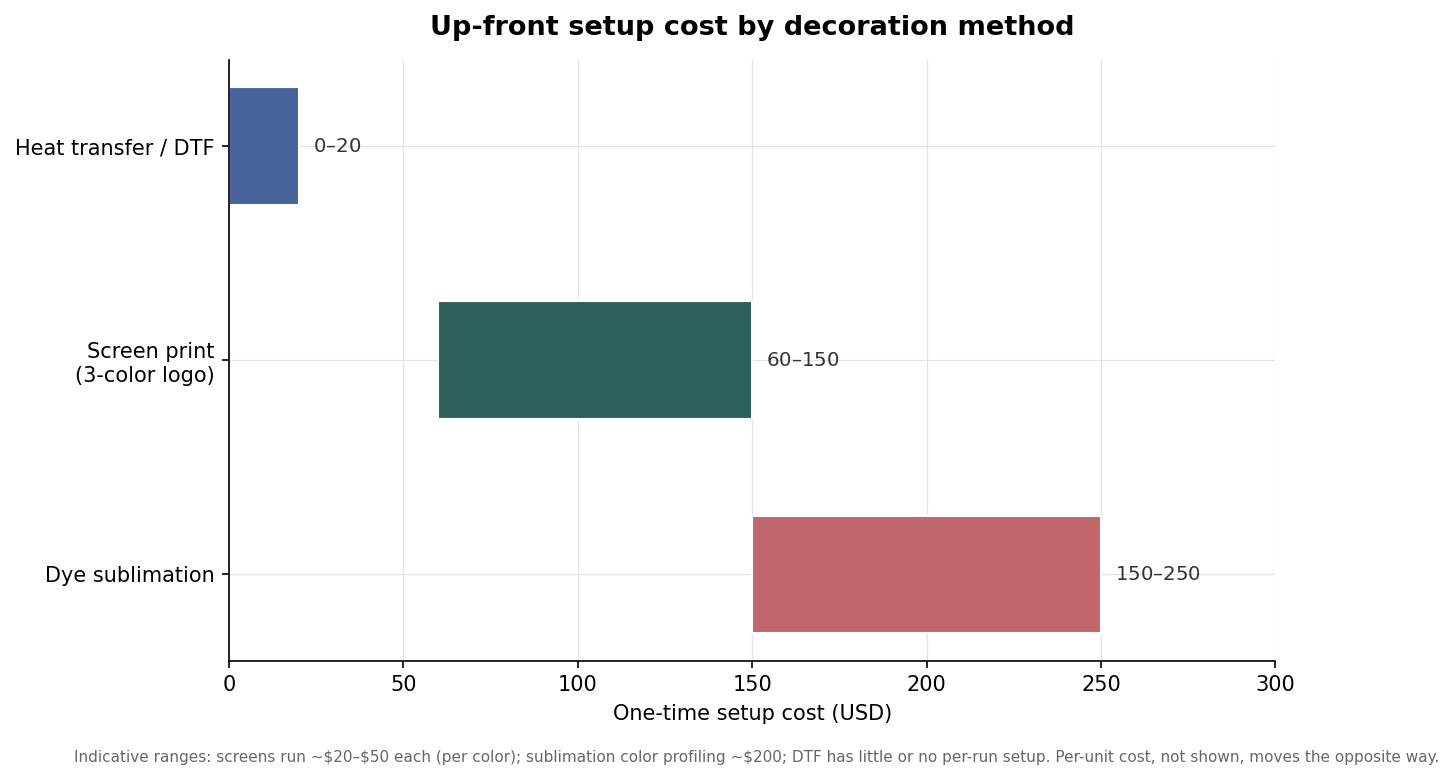
The catch is fabric color. Sublimation ink is translucent, so it only reads correctly on white or light polyester; you cannot sublimate a light logo onto a black cover, because there is no white ink to lay down first. It also carries a higher setup cost, on the order of $200 for color profiling, and printers usually set a higher minimum order to justify that. If your art is rich and your covers are light, sublimation is hard to beat. If you need dark covers, it is off the table before you start.
Screen printing: few colors, any fabric, cheapest at scale
Screen printing pushes thick ink through a stencil, one screen per color. Because the ink is opaque, it works on any fabric color, including dark neoprene where sublimation fails, and when it is properly cured it resists scratching and peeling for years. The trade-off is that each color needs its own screen, so a one- or two-color logo is cheap to set up while a full-color image is impractical. Expect the ink to add a slight tactile texture; plastisol inks in particular can feel a touch stiff over a stretch cover.
The economics are where screen printing wins. Screens run roughly $20 to $50 each, so setup for a three-color logo lands somewhere in the low hundreds, but the per-unit cost drops sharply as the run grows, falling under a dollar for the decoration itself at several thousand pieces. That profile, high fixed cost and low variable cost, is exactly what you want for a dealership giveaway run or a fleet program where you are ordering hundreds or thousands of the same clean logo.
Heat transfer and DTF: detail without the setup, built for small runs
Direct-to-film transfer prints your design, gradients and photographic detail included, onto a coated film, then heat-presses it onto the cover with an adhesive layer. It gives you sublimation-grade detail without the profiling cost, and its practical minimum order runs as low as ten to a hundred pieces, which makes it the right tool for prototypes, small events, or a short run you need quickly. The two things to watch are feel and durability: because the transfer sits on the surface, its adhesive can stiffen the fabric and slightly reduce the stretch, and how long it lasts depends on the film and press quality. Per unit it costs more than screen printing, so it rarely makes sense once you are ordering in the thousands.
What it actually costs once everything is added up
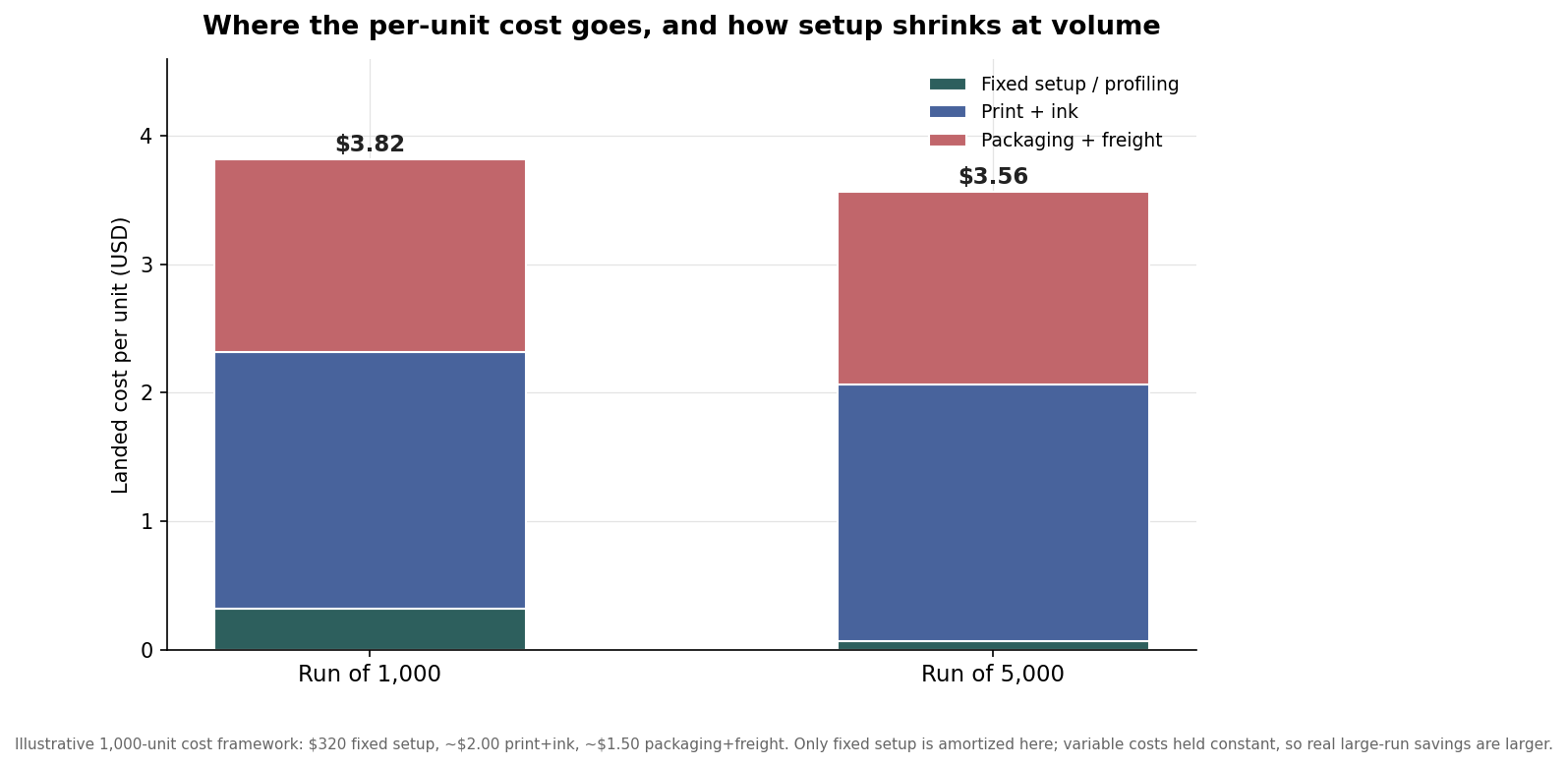
Decoration is only one line on the invoice. The blank cover, its construction, packaging, and freight all stack on top, and the total is what you should compare between quotes. As a rough industry benchmark, a run of 1,000 printed covers can land somewhere around $3.80 per unit all-in, split across a fixed setup charge, the print and ink, and packaging plus freight. The single most useful thing to understand about that number is how it moves with quantity. The setup is a fixed cost, so it shrinks per unit as the run grows; the same logo genuinely costs a different amount at 100 pieces than at 5,000, and most of that difference is setup being spread thinner. Treat any per-unit figure as indicative and tie your real decision to a quote at your actual quantity.
Matching the method to your order
The decision usually makes itself once you name three things: how many colors are in the art, how many covers you need, and whether the fabric is light or dark. A clean one- to three-color logo on a large order points straight at screen printing, which will be the cheapest per unit and holds up on any fabric color. Full-color or photographic art on light covers, ordered in volume, is sublimation territory, where the print is permanent and invisible to the touch. A detailed design in a small quantity, or anything you need fast without paying for setup, is where DTF earns its place. The genuinely hard combination is multi-color art on a dark cover, because sublimation cannot lighten the fabric and full-color screen printing gets expensive; the usual answers are to screen print with a white underbase or to switch to light covers and sublimate. Embroidery, worth mentioning only to rule it out, is uncommon on stretch covers because the stitched area fights the stretch and puckers.
Whichever method you choose, ask for a proof, and for sublimation or DTF ask specifically for a printed swatch on the same fabric you are ordering. A screen shows color in RGB and the press prints in CMYK, so the on-screen version almost always looks brighter than the finished cover. Seeing true color on the real material, before the full run, is the cheapest mistake-catcher in the whole process.