A custom steering wheel cover only earns its keep if it grips the wheel snugly. Get the fit wrong and even a perfectly printed design fights you every time you turn: a cover that is too tight blocks the thumb buttons and never seats fully, while one that is too loose rotates in your hands, which is a real safety problem rather than a cosmetic one. Two measurements decide the fit, and a short list of decisions after that determines how the finished cover looks and how long it lasts. Here is how to specify one properly.
Start with the two measurements that decide fit
Every steering wheel comes down to two numbers: diameter and grip thickness. Diameter is the straight-line distance across the wheel, measured from the outer edge of the rim on one side to the outer edge on the other, straight through the center. Most passenger-car wheels land between 14.5 and 15.5 inches. Grip thickness is how chunky the rim itself is; wrap a soft tape measure around the cross-section of the rim to capture it. A thicker grip suits larger hands and a sportier feel, while a thinner rim reads sleeker.
Measure the wheel itself rather than guessing from the make and model. Two cars in the same class can wear slightly different wheels, and a half-inch of diameter is the difference between a cover that snaps into place and one that never sits right. If your printer or the product listing asks for grip circumference instead of thickness, that is simply the tape measurement all the way around the rim’s cross-section; on most cars it lands in the low-to-mid single-digit inches, and a heated or sport wheel usually reads at the thicker end.
Match your diameter to a size class
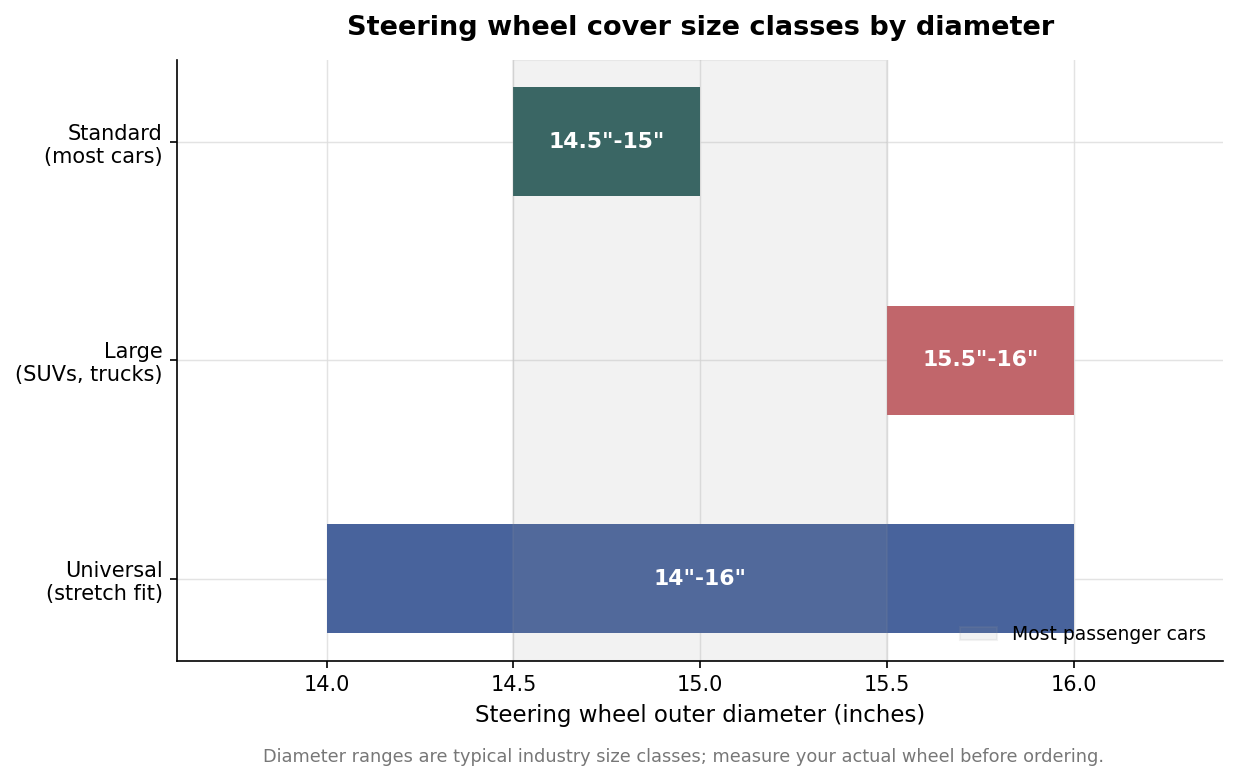
Covers are sold in a handful of size classes rather than one per vehicle. A standard cover fits roughly 14.5 to 15 inches and covers most compact and mid-size cars such as the Civic, Corolla, and Focus. A large cover runs about 15.5 to 16 inches for full-size SUVs and trucks like the Tahoe, F-150, and Ram. A universal cover stretches across a 14 to 16 inch span using a more elastic construction, trading a little precision for broader fit. If your wheel sits on the boundary between two classes, choose based on the material’s stretch: a forgiving stretch-fit cover sizes down comfortably, while a stiff one does not.
Choose a material for your climate and how you drive
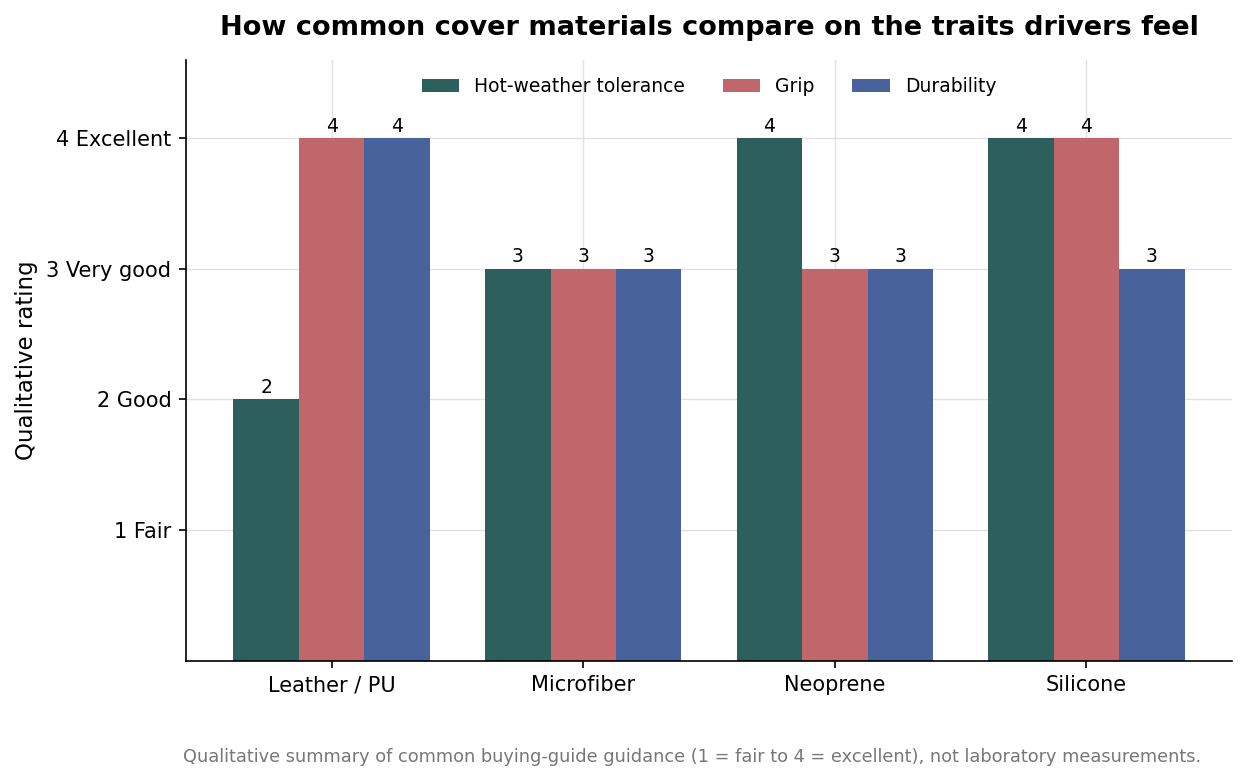
Material sets the feel, the durability, and how the cover behaves in a hot or cold car. Leather and PU leather give premium looks and excellent grip and age well, but they can get uncomfortably hot in direct sun and want occasional conditioning. Microfiber is the value all-rounder: soft, more stain-resistant than real leather, and comfortable across temperatures. Neoprene, the same material used in wetsuits, is the all-weather workhorse: water-resistant, UV-tolerant, and insulating against both heat and cold. Silicone delivers excellent anti-slip grip and heat tolerance in vibrant colors, though it attracts dust and lint.
For a custom cover, the material also decides how your artwork prints. Full-color designs are usually put down on neoprene or polyester by dye sublimation, which bonds the ink into the fabric so it survives a hot dashboard without cracking or peeling. If your priority is a bold printed design that lasts, a sublimated neoprene or polyester base is typically the right call; if it is a solid-color premium feel, leather or microfiber makes more sense.
Design and print details that make or break a custom cover
A steering wheel is a curved surface that a driver’s hands cover most of the time, so layout matters more than on a flat print. Place your most important element, a logo or short line of text, at the bottom center of the wheel where it stays visible while driving; artwork at the top and sides disappears under the hands and the dash. Keep the design bold and high-contrast, because fine lines and thin text blur on a wheel that is always slightly turning. Send print-ready art as vector or at 300 DPI at the final size, and remember that sublimation can shift very light pastels and pure whites, so proof those colors carefully.
Construction is a safety detail, not just a finishing one. The cover needs a snug elastic edge or a backing that holds tension so it cannot creep or rotate. Ask how the seam is placed and whether the artwork runs continuously around the wrap or breaks at panels, since a seam through the middle of a logo is a common and avoidable disappointment.
Fitting the cover once it arrives
A well-sized cover is supposed to be a workout to put on, and that resistance is exactly what stops it from rotating later. On a cold day, let the cover warm to room temperature first, or set it in the sun for a few minutes, so the material relaxes and stretches. Hook the bottom edge over the base of the wheel, then work the cover upward and outward with both thumbs, walking it around the rim a little at a time rather than yanking one section fully over. Seat the top last. If it slides on with no effort at all, it is too big and will slip; if you cannot get it past halfway even warm, it is a size too small. A cover that takes real effort and then sits flush is the one that will stay put for years.
A pre-order checklist
Before you place the order, confirm six things. Measure the actual wheel’s diameter and grip thickness; pick the size class that matches; choose the material for your climate and whether the cover is printed; position the key artwork at the bottom center; supply print-ready, high-contrast art at the final size; and verify the closure or backing that keeps the cover from slipping. Run through those and a custom steering wheel cover arrives fitting the wheel and reading the way you designed it, instead of teaching you what you should have measured the first time.
Leave a Reply